Parents and educators are asking a practical question: what are the latest trends in educational toys? The answer is changing quickly. Connected play, sensory exploration, coding, sustainability, and inclusive design now shape many product decisions.
Grand View Research identifies educational toys as a growing global market, supported by demand for early learning and skill development. Circana’s global toy industry reporting also shows a pressured market, where families increasingly compare price with meaningful play value. These findings suggest that educational toys must do more than look attractive on a shelf. They should invite children to build, test, adjust, and try again.
Kathy Hirsh-Pasek, a developmental psychologist and playful-learning researcher, says, “Play is not just about having fun but about taking risks, experimenting, and testing boundaries.” Her view helps explain why open-ended construction sets, programmable robots, and tactile STEM kits remain influential. They give children visible feedback, such as a moving gear, a failed bridge, or a light that finally turns on.
The newest products also connect physical play with carefully designed digital support. However, more technology does not automatically create better learning. That assumption needs review. The best toys often leave room for imagination, conversation, movement, and quiet concentration.
This outline examines the leading trends shaping educational toys today. It considers what current market reports reveal, what child-development research supports, and where the industry still needs stronger evidence. Some trends appear promising. Others may be clever packaging in disguise.
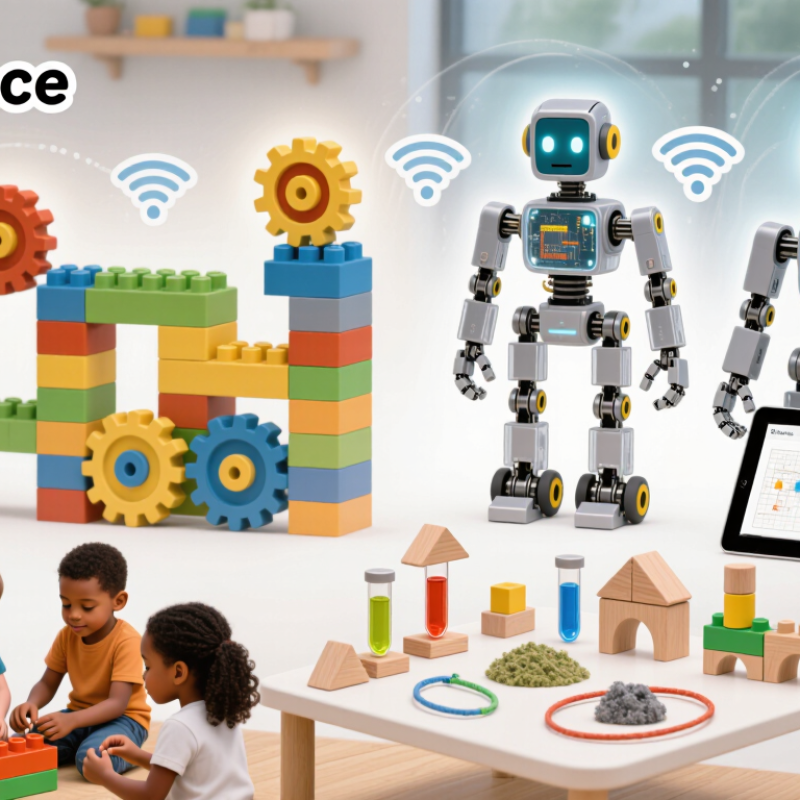
What are the top 10 latest trends in educational toys? More importantly, what makes one genuinely educational? A modern toy should invite active thinking, not simply flash lights or repeat answers. Current trends include open-ended STEM kits, screen-light coding, robotics, augmented reality, sensory-friendly design, social-emotional play, eco-conscious materials, adaptive learning, inclusive storytelling, and collaborative problem-solving.
Learning value depends on the child’s action. A construction set becomes educational when children test balance, revise designs, and explain their choices. The World Economic Forum’s Future of Jobs Report 2025 identifies analytical thinking as a leading workplace skill. This supports toys that encourage questioning and experimentation. However, adaptive software should not pretend to replace a teacher or caregiver. UNESCO’s 2023 Global Education Monitoring Report warns that technology helps learning only when its use is purposeful and supported by sound teaching.
Less screen time can be better.
The OECD’s PISA 2022 results found that about 30% of students reported distraction from digital devices in most or every mathematics lesson. A well-designed modern toy therefore combines digital feedback with physical movement, conversation, and quiet concentration. Materials should feel durable, safe, and repairable. Instructions should offer several difficulty levels without making failure embarrassing. Industry sales data also deserves caution: Circana reported a 7% decline in global toy sales during 2023, suggesting that novelty alone cannot guarantee value. In practice, I would question any toy that claims to build intelligence without showing what children actually do, say, or create during play.
Modern educational toys combine purposeful play, age-appropriate challenge, active participation, and clear learning outcomes. The chart presents an evidence-informed learning-value score from 1 to 5, based on the learning domains each trend can support, including problem-solving, creativity, language, STEM reasoning, collaboration, and self-regulation.
Learning value is strongest when toys encourage children to make decisions, test ideas, communicate, and create rather than simply follow predetermined steps. The framework is aligned with findings from research on guided play, construction play, computational thinking, social-emotional learning, and active learning published by organizations and academic journals including UNICEF, OECD, the American Academy of Pediatrics, and the American Journal of Play.
Technology is reshaping educational toys from simple objects into responsive learning tools. Artificial intelligence can adjust puzzles, reading levels, and problem-solving tasks to a child’s progress. Augmented reality adds animated layers to maps, science cards, and anatomy models. Coding toys now teach logic through visible movement, sound, and immediate feedback.
Other growing trends include robotics, voice interaction, sensory-friendly design, collaborative online play, and toys made from more sustainable materials. Adaptive systems can support different learning speeds, but they are not perfect. A child may solve a task by guessing rather than understanding it. Screen-based features can also distract from hands-on discovery. Teachers and parents should check whether technology supports a clear learning goal, not merely creates excitement. Evidence from classroom trials and child-development research remains important.
Tips: Choose toys with adjustable difficulty and offline activities. Watch how the child uses the toy for ten minutes. Ask, “What did you discover?” Check privacy settings before connecting any device. Limit automated hints, because productive struggle builds reasoning. Look for readable instructions, durable parts, and accessible controls. A simple building kit may still teach more than an expensive smart toy.
Educational toys are moving beyond bright colors and basic puzzles. The strongest trend is inclusive design. Products now use tactile symbols, high-contrast pieces, adjustable sounds, and larger grips. These features support children with visual, hearing, motor, and communication differences. UNICEF reported that nearly 240 million children worldwide live with disabilities in its 2021 report. That figure makes accessibility a core design responsibility, not a small market opportunity.
Design matters.
Another trend is modular play. Children can change difficulty, attach pieces, or choose visual, audio, and touch-based instructions. Multilingual prompts and screen-free communication tools also widen participation.
The WHO and UNICEF Global Report on Assistive Technology (2022) found that more than 2.5 billion people need assistive products, while nearly 1 billion lack access in lower-income countries. Educational toys should therefore offer affordable adaptations, not expensive specialist versions.
Simple pieces can help.
Educators increasingly evaluate sensory comfort, packaging, and classroom usability. Quiet mechanisms, soft textures, predictable feedback, and easy-open boxes can reduce frustration. Co-play features also let children with different abilities solve tasks together.
However, some products still mistake inclusion for adding a single accessibility feature. That approach is too narrow. Families and teachers should be consulted during testing, especially those with lived experience of disability. No checklist catches every child. Better toys remain flexible, repairable, and understandable without lengthy instructions. Further progress will require honest testing, clearer evidence, and fewer assumptions about how children learn.
Educational toy design is moving beyond bright colors and clever sounds. Recycled wood fiber, plant-based plastics, and water-based inks are becoming more common. Designers also favor modular parts that children can replace instead of discarding the whole toy. Repair guides, refillable activity pieces, and low-energy electronics support longer product life. These choices reduce waste, but they are not automatically sustainable. Material sourcing, production energy, packaging, and disposal all need careful review.
Safety comes first. New toys increasingly use rounded edges, secure battery compartments, non-toxic coatings, and larger components for younger children. Independent laboratory testing can check strength, chemical exposure, flammability, and small-part risks. Clear age guidance matters too. A puzzle with loose magnets may support advanced learning, yet it can create serious hazards for toddlers. Designers should test toys with children, caregivers, and educators in realistic settings. Classroom use often reveals problems that factory checks miss, such as slippery pieces or confusing instructions.
Inclusive design is another growing trend. Toys now include textured surfaces, quieter controls, adjustable difficulty, and visual or tactile feedback. Screen-free STEM kits are also gaining attention because they encourage hands-on problem-solving. Still, sustainable materials may feel less smooth, and electronic features can shorten a toy’s useful life. That trade-off deserves honest discussion. Better design may mean fewer features, stronger construction, and room for children to invent their own rules.
Parents and educators should evaluate trends, not simply follow them. Popular options now include STEM kits, coding toys, sensory tools, open-ended building sets, eco-conscious materials, augmented reality, social-emotional games, inclusive designs, maker activities, and adaptive learning toys. Each trend should serve a clear developmental purpose. A coding toy may strengthen sequencing, but only when children understand the problem they are solving. A sensory kit should offer safe textures, washable parts, and suitable supervision.
Look closely at how children use the toy. Does it encourage questions, cooperation, movement, or quiet concentration? Check age guidance, choking risks, material information, durability, and cleaning needs. For digital products, educators should examine screen time, data protection, offline access, and whether an adult can control settings. Small details matter. A five-year-old may abandon a complicated kit after one confusing instruction. An open-ended set may create more learning with fewer parts.
Evidence also deserves attention. Read independent testing, teacher feedback, and developmental research rather than relying on exciting claims. Observe whether the toy supports different abilities, languages, and learning styles. My own first impression can be misleading; a bright electronic toy may look engaging but produce little meaningful play. Families can trial one activity, note the child’s response, and adjust expectations. Even well-designed toys need patient guidance, because play does not always unfold as the instructions predict.
Artificial intelligence can adjust puzzles, reading levels, and problem-solving tasks to a child’s progress. The toy may become easier or harder. However, correct answers can sometimes come from guessing.
Augmented reality can place animated layers over maps, science cards, and anatomy models. A child might see movement on a flat card. Excitement alone does not guarantee understanding.
Coding toys show logic through movement, sounds, and immediate feedback. A child can change commands and watch a small object respond. Visible mistakes help, though not every child enjoys repeated testing.
Choose them only when the screen supports a clear learning goal. Compare screen time with building, sorting, drawing, and physical discovery. Sometimes a simple kit teaches more.
Look for rounded edges, secure battery compartments, non-toxic coatings, and larger parts for younger children. Independent testing can examine strength, chemicals, flames, and small-part risks. Age guidance matters greatly.
Recycled wood fiber, plant-based plastics, and water-based inks can reduce certain environmental impacts. Replaceable parts, repair guides, and refillable pieces may extend product life. Still, material sourcing and disposal need review.
Inclusive toys may offer textured surfaces, quieter controls, adjustable difficulty, and visual or tactile feedback. Accessible controls can support children with different sensory or motor needs. Designers should test toys with real users.
Watch the child use it for ten minutes. Ask, “What did you discover?” Check privacy settings, limit automatic hints, and inspect the instructions. I may overvalue novelty; careful observation reveals more.
Modern educational toys are designed to make learning active, meaningful, and enjoyable. Rather than focusing only on memorization, they help children develop problem-solving, creativity, communication, coordination, and critical-thinking skills through play. When asking “what are the latest trends in educational toys,” it is important to consider interactive technology, hands-on experimentation, coding concepts, adaptive learning, and toys that encourage collaboration instead of passive screen use.
New designs are also becoming more inclusive, accessible, sustainable, and safety-conscious. Toys may include adjustable difficulty levels, sensory-friendly features, diverse characters, recyclable materials, durable construction, and age-appropriate designs. Parents and educators can evaluate these trends by checking whether a toy supports clear learning goals, matches a child’s development, protects privacy, encourages independent thinking, and provides lasting value. The best educational toys balance innovation with simplicity, safety, creativity, and genuine opportunities for children to explore and learn.

Ebid Toy